
Does Suboxone Interact With Other Drugs & Medications?
%20(1).avif)
Table of Contents
Suboxone interacts with certain medications. Sometimes, other medications may enhance the effects of your Suboxone, making it too sedating. Other times, other medications may weaken the effects of the Suboxone resulting in under-dosing.
Doctors are aware of the problems drug interactions can cause. About 7,000 people die each year due to medication interactions.[1]
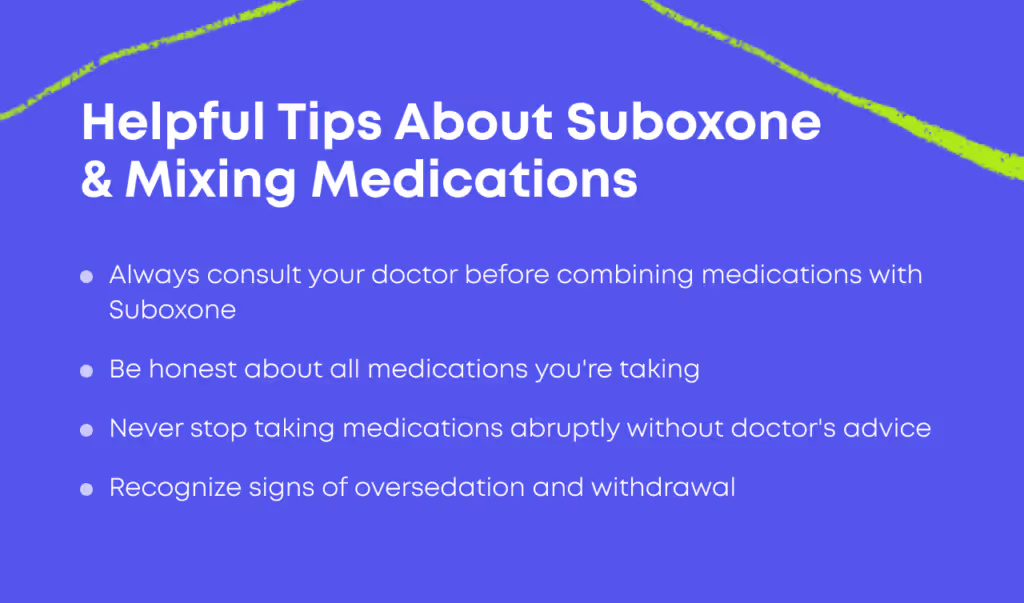
Preventing this problem is a priority. Before you fill your Suboxone prescription, talk to your doctor about any and all other medications you are taking. Answering questions honestly, and talking to your doctor and pharmacist before adding anything new to the mix, can help you avoid a medication interaction.
What Medications Does Suboxone Interact With?
Suboxone is an effective medication for OUD. At the proper dose, it isn’t sedating or incapacitating.
Most people who use Suboxone for OUD feel simply normal on the medication (rather than high). But some people feel sedated while on Suboxone, and adding other sedating medications along with Suboxone can sometimes enhance these effects.
Sometimes, that’s beneficial.[2] If you’re using medication to help you sleep or calm down, sedation could help. But too much sedation can mean slow breathing, leading to unconsciousness. People can die from oversedation.
Conversely, some medications block Suboxone’s action. Using a drug like Naltrexone could reverse the effects of Suboxone, causing acute withdrawal symptoms.
Drugs That Interact with Suboxone
Researchers have examined Suboxone’s connection with other common drugs, and they’ve created a list of substances you should avoid while treating your OUD. These substances typically appear on banned lists.
Suboxone & Naltrexone/Naloxone
ReVia and Vivitrol both contain naltrexone, an opioid antagonist.[3] Using an opioid antagonist while taking Suboxone will block partial opioid (buprenorphine) from working. This can cause the acute onset of withdrawal symptoms. Patients may feel very sick with acute withdrawal symptoms if this happens. While this is not life threatening, it can be extremely uncomfortable and can even motivate people to return to opioid use to make the symptoms abate, putting them at risk for relapse.
Suboxone & Antidepressants
Many people struggle with depression and anxiety while in recovery. While most antidepressant medications (Prozac, Zoloft, Citalopram, Escitaloprma, etc) are not sedating, some are (mirtazapine, Seroquel, Risperdal, etc), and when combined with Suboxone, they can cause over sedation.
Never stop taking antidepressants without telling your doctor. You could experience severe withdrawal symptoms, such as irritability, anxiety, and insomnia — all of which increase your relapse risks.[4] You may need to taper doses instead of quitting suddenly.
Suboxone & Benzodiazepines
Benzodiazepines are a class of medications used to treat seizures, and, in extreme cases, anxiety and certain other sleep and mental health disorders. Since benzodiazepines can also be sedating, they may interact with Suboxone.
Benzodiazepines include the following:
- Ativan (lorazepam)
- Klonopin (clonazepam)
- Restoril (temazepam)
- Xanax (alprazolam)
- Valium (diazepam)
Never stop taking benzodiazepines abruptly. Always talk to your doctor about stopping slowly.
Suboxone & Opioids
Suboxone is a partial opioid agonist, which means, to a certain degree, it will block the action of a full opioid agonist. If you need to use an opioid for pain control in addition to your Suboxone, talk to your doctor. You may need higher doses, or you may need to temporarily discontinue your Suboxone, in order to achieve adequate pain control.
Common prescription opioids include the following:
- OxyContin
- Codeine
- Morphine
- Vicodin
Suboxone & Seizure Medications
Some seizure medications decrease the effect of your Suboxone. Some seizure medications can also be sedating, which might be compounded by concurrent use of Suboxone.
Troublesome seizure medications may include the following:
- Dilantin (phenytoin)
- Phenobarbital
- Tegretol (carbamazepine)
- Depakote (Valproic Acid)
Speak With Your Doctor
Most medications, even most sedating medications, are safe to take with Suboxone. However, it is always best to talk to your doctor about any and all other medications you are taking while you are on Suboxone in order to ensure that your OUD therapy is working optimally and not interacting with other medications.
Let your doctor help you. Be open and honest, and always talk with your doctor before combining medications with your Suboxone.
Sources
- Preventable Adverse Drug Reactions: A Focus on Drug Interactions. U.S. Food and Drug Administration. https://www.nami.org/About-Mental-Illness/Treatments/Mental-Health-Medications/Types-of-Medication/Buprenorphine/Buprenorphine-Naloxone-(Suboxone). March 2018. Accessed November 2022.
- Sedation: The Ups and Downs of a Side Effect. Psychiatric Times. https://www.psychiatrictimes.com/view/sedation-ups-downs-side-effect. April 2019. Accessed November 2022.
- Naltrexone (ReVia). National Alliance on Mental Illness. https://www.nami.org/About-Mental-Illness/Treatments/Mental-Health-Medications/Types-of-Medication/Naltrexone-(ReVia). January 2021. Accessed November 2022.
- Fluoxetine. National Library of Medicine. https://medlineplus.gov/druginfo/meds/a689006.html. January 2022. Accessed November 2022.
- Fluconazole. National Health Service. https://www.nhs.uk/medicines/fluconazole/. March 2020. Accessed November 2022.
- Research Suggests Benzodiazepine Use is High While Use Disorder Rates are Low. National Institute on Drug Abuse. https://nida.nih.gov/news-events/science-highlight/research-suggests-benzodiazepine-use-high-while-use-disorder-rates-are-low. October 2018. Accessed November 2022.
- Indinavir. National Library of Medicine. https://medlineplus.gov/druginfo/meds/a696028.html. May 2018. Accessed November 2022.
- Buprenorphine/Naloxone (Suboxone). National Alliance on Mental Illness. https://www.nami.org/About-Mental-Illness/Treatments/Mental-Health-Medications/Types-of-Medication/Buprenorphine/Buprenorphine-Naloxone-(Suboxone). January 2021. Accessed November 2022.
- Suboxone
Elena Hill, MD, MPH
Elena Hill, MD; MPH received her MD and Masters of Public Health degrees at Tufts Medical School and completed her family medicine residency at Boston Medical Center. She is currently an attending physician at Bronxcare Health Systems in the Bronx, NY where she works as a primary care physician as well as part time in pain management and integrated health. Her clinical interests include underserved health care, chronic pain and integrated/alternative health.