
What Does the OxyContin High Feel Like?


Table of Contents
Like all opioids, oxycodone (OxyContin) is a pain medication that can also create a “high” if taken at high doses.
People who have experienced an OxyContin high often describe it as a state of feeling extreme well-being, safety, warmth and relaxation.[1, 2]
This sensation can be very pleasurable and turns on the brain’s “reward system,” encouraging people to use the drug over and over again to obtain this euphoric state. However, with repeated use, patients can become dependent on OxyContin, leading to an opioid use disorder (OUD).
Does OxyContin Make You High?
How Does OxyContin Make You Feel?
OxyContin can cause a range of physiological and psychological effects, depending on how much you take, how you take it, your tolerance, and your individual physiology and drug likeability. An OxyContin high can cause desirable effects, such as:[1],[2][3]
- Feelings of pleasure and well-being
- Relaxation
- Warmth
- Feeling safe and loved
- Pain-relief
However, oxycodone misuse and use can also cause unpleasant side effects, such as:[3].[5]
- Confusion
- Nausea and vomiting
- Constipation
- Dizziness
- Severe drowsiness
- Slowed breathing and heart rate
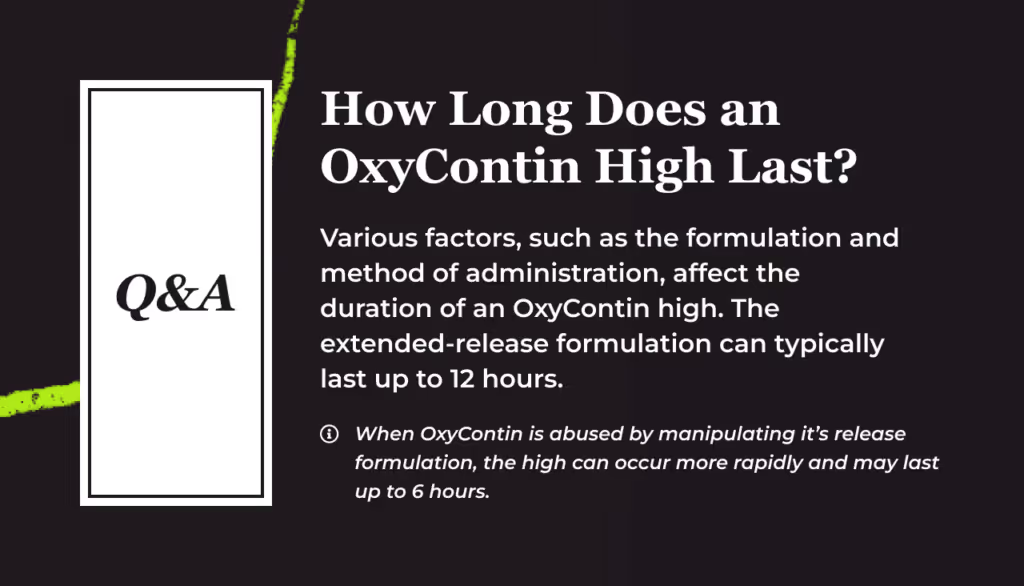
How Long Does an OxyContin High Last?
The duration of an oxycodone high depends on many factors, such as:
- Whether it is immediate-release or extended-release
- Method of administration (injecting or snorting results in a faster onset of effects and shorter but more intense high)
- Your tolerance
- Your oxycodone dose
- Your individual physiology
If you are using or misusing the immediate-release OxyContin formulation, you may experience pain relief and other pleasurable effects within 15 to 30 minutes, although the effects reach their peak within about an hour of use. Oxycodone will work for between 3 and 6 hours. [6]
Meanwhile, the extended-release version of OxyContin will last longer, although the high or euphoric effects will likely be less intense because of how the medication is slowly released into your bloodstream.
Why Does OxyContin Get You High?
All opioids, including oxycodone, bind to opioid receptors in the brain. Opioid receptors are incredibly complex and lead to a number of different effects in the body. However, simply put, they fundamentally release a chemical called dopamine, which is often referred to as the “reward” neurotransmitter.
Dopamine creates feelings of pleasure and euphoria. Your brain cells release this chemical naturally when exposed to something pleasant (like a tasty meal). But OxyContin’s release of dopamine is greater and more rapid than that of other rewards, creating an artificial feeling of euphoria, or a “high.” [4]
What Are the Risks of an OxyContin High?
The first and most immediate risk of oxycodone high is an overdose. When opioids bind in the brain, they produce a number of effects, including suppression of the hindbrain, which is responsible for our automatic urge to breathe. If this is suppressed, the body can spontaneously stop breathing. This is called an opioid overdose.
An OxyContin overdose causes the following symptoms:[5]
- Pale or clammy skin
- Limp body
- Bluish-colored fingernails or lips
- Vomiting
- Unresponsiveness
- Slow or stopped breathing
An overdose is a medical emergency. Quick administration of the opioid blocker, naloxone, can reverse an overdose, and should always be available for anyone using oxycodone, either legally or illegally.
More long term, oxycodone carries a very high risk of addiction and opioid use disorder (OUD). This addiction can develop very slowly or very quickly depending on the individual. Some people have reported developing an addiction after just one prescription.[6]
Overcoming OxyContin With MAT
While people may start using OxyContin to get high or even simply to treat pain, they may keep using it to avoid withdrawal. Brain cells become accustomed to the drug, and when it’s absent, people develop significant flu-like symptoms.[6] Medication for Addiction Treatment (MAT) programs can help.
In an MAT program, doctors use prescriptions like Suboxone (buprenorphine/naloxone) to manage opioid use disorder. The partial opioid agonist in Suboxone latches to opioid receptors in the brain. As it works, it reduces withdrawal symptoms and opioid cravings.
Telemedicine providers like Bicycle Health bring MAT expertise to you through virtual visits. When you work with us, you can conduct your appointments via video chat, and pick up your prescriptions at your local pharmacy. You can also participate in counseling sessions virtually, so you can build a healthier life.
Contact us to find out more about how this works and see if it’s right for you. You can get started on your recovery today.
- Oxycontin
Peter Manza, PhD
Peter Manza, PhD received his BA in Psychology and Biology from the University of Rochester and his PhD in Integrative Neuroscience at Stony Brook University. He is currently working as a research scientist in Washington, DC. His research focuses on the role of the brain dopamine system in substance use disorders and in aging. He also studies brain function in obesity and eating disorders.
Sources
- Opioids Can Feel Like Love. Here’s How That Helps Our Understanding of Addiction. WBUR. https://www.wbur.org/onpoint/2021/12/16/the-void-opioids-fill. December 2021. Accessed April 2023.
- What Is Heroin and What Does It Feel Like? Drug Policy Alliance. https://drugpolicy.org/drug-facts/what-is-heroin. Accessed April 2023.
- Prescription Opioids DrugFacts. National Institute on Drug Abuse. https://nida.nih.gov/publications/drugfacts/prescription-opioids. June 2021. Accessed September 2023.
- Attractiveness of Reformulated OxyContin Tablets: Assessing Comparative Preferences and Tampering Potential. Journal of Psychopharmacology. https://journals.sagepub.com/doi/pdf/10.1177/0269881113493364. June 2013. Accessed April 2023.
- Opioids and Opioid Use Disorder. U.S. National Library of Medicine. https://medlineplus.gov/opioidmisuseandaddiction.html. April 2018. Accessed April 2023.
- Oxycodone Oral Immediate Release Pill. OncoLink, University of Pennsylvania. https://www.oncolink.org/cancer-treatment/oncolink-rx/oxycodone-oral-immediate-release-pill-roxicodone-r-percolone-r. September 2021. Accessed September 2023.
- Chasing the Dragon Discussion Guide. U.S. Drug Enforcement Administration. https://www.dea.gov/sites/default/files/resource-center/Publications/Chasingthedragon3.pdf. Accessed April 2023.
- Buprenorphine in the United States: Motives for Abuse, Misuse, and Diversion. Journal of Substance Abuse Treatment. https://www.sciencedirect.com/science/article/pii/S0740547218304720. September 2019.