
Naloxone/Opioid Overdose Reversal Education
Table of Contents
What Is Naloxone?
Naloxone is a medication that can quickly reverse an overdose from prescription opioid painkillers or illicit opioids such as heroin and fentanyl. It comes in several forms, including an intramuscular injection and a nasal spray. Naloxone nasal spray is available over the counter, without a prescription.
Naloxone has no effect on someone who does not have opioids in their system, and it is not a treatment for opioid use disorder. It works on prescription painkillers, such as oxycodone (OxyContin®) and hydrocodone (Vicodin®), as well as illicit opioids like heroin and fentanyl.
NARCAN® Nasal Spray was the first FDA-approved nasal formulation of naloxone for known or suspected opioid overdose. It is needle-free and ready to use.
Why Should I Keep Naloxone at Home?
If anyone in your home has a prescription for opioid medication, keeping naloxone on hand is a smart safety measure. Trained individuals can safely give naloxone to anyone experiencing an opioid overdose, including young children and infants.
Ohio residents can get free naloxone through the Ohio Department of Health at naloxone.ohio.gov.
Who Should Carry Naloxone?
We recommend that everyone carry naloxone at home and in public. The following people are at higher risk of an opioid overdose and are especially encouraged to carry it:
- People living with active opioid use disorder, and their family and friends
- People recently released from a residential substance use disorder treatment facility
- People with opioid use disorder who were recently released from jail or prison
- People taking high-dose opioids to manage chronic pain
When Should I Use Naloxone?
Give naloxone to anyone who shows signs of an opioid overdose. These include:
- Blue or purple fingernails and lips
- No response to voice or touch
- Pinpoint pupils (the center of the eye is very small)
- Slow, irregular, or stopped breathing
- Slow heartbeat or low blood pressure
- Pale, clammy skin
Naloxone is safe to use whenever an opioid overdose is suspected. If the person is not overdosing on opioids, or not overdosing at all, naloxone will not harm them. When in doubt and overdose signs are present, don't be afraid to use it.
Fentanyl and the "One Pill Can Kill" Campaign
The DEA's One Pill Can Kill campaign warns the public about fentanyl being mixed into street drugs, including cocaine, heroin, and methamphetamine. Counterfeit pills made to look like prescription painkillers (such as oxycodone), sedatives (such as Xanax), and stimulants (such as Adderall) are easy to buy through social media and fake online pharmacies. According to the DEA, as little as 2 milligrams of fentanyl can be a deadly dose for someone without a tolerance to opioids.
Because fentanyl is so common in the street drug supply, give naloxone to anyone you believe is overdosing. There is a strong chance fentanyl is involved. Fentanyl is 50 to 100 times more potent than morphine, so an overdose can happen quickly. Give naloxone first, then call 911 to get medical help on the way as soon as possible.
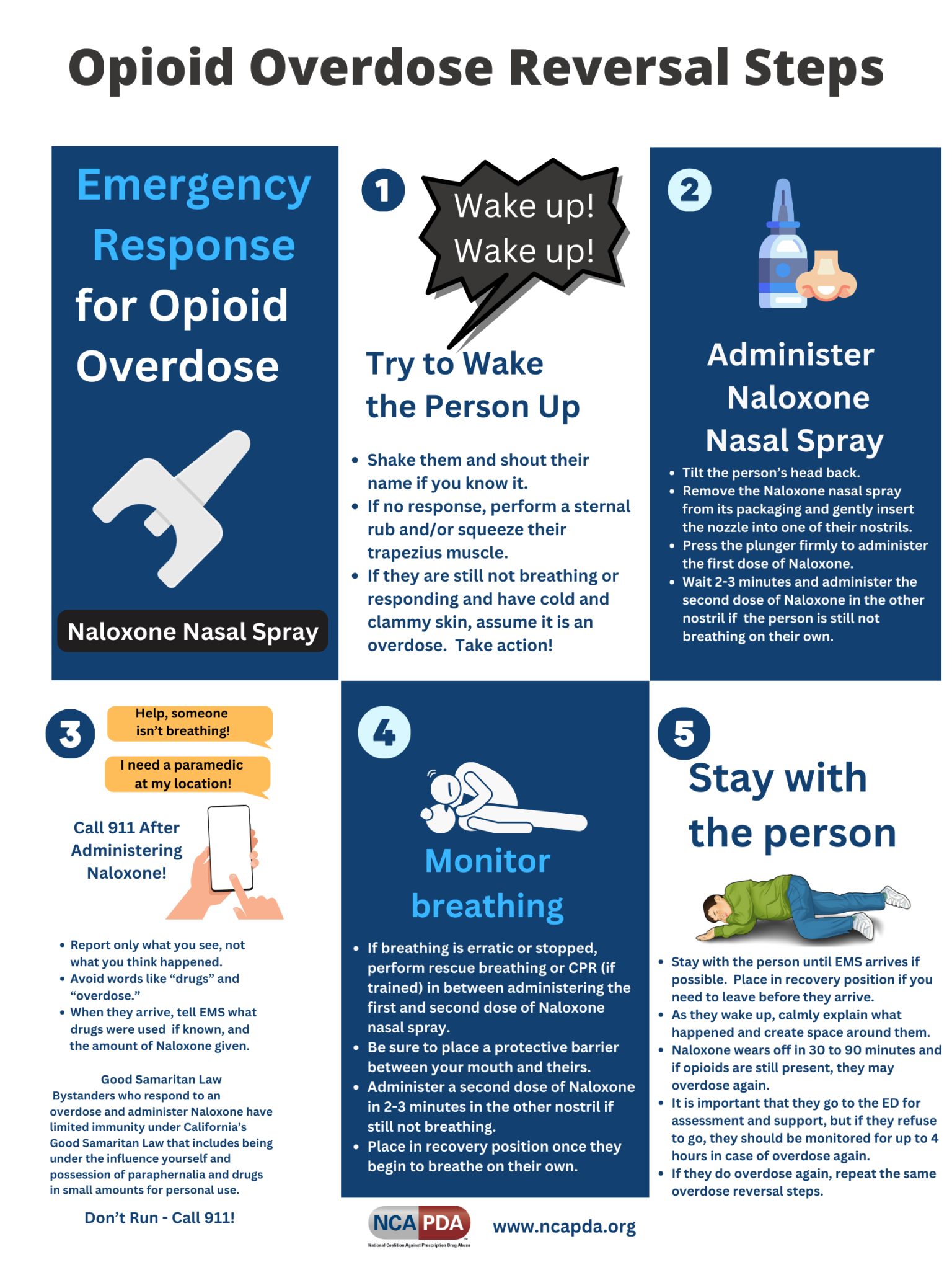
How to Reverse an Opioid Overdose in 5 Steps
1. Try to Wake the Person Up
- Shake them and shout their name if you know it.
- If there is no response, do a sternal rub (rub your knuckles firmly on their breastbone) and/or squeeze their trapezius muscle (between the neck and shoulder).
- If they are still not breathing or responding and have cold, clammy skin, assume it is an overdose and take action.
2. Give Naloxone Nasal Spray
- Tilt the person's head back.
- Remove the naloxone nasal spray from its packaging and gently insert the nozzle into one nostril.
- Press the plunger firmly to give the first dose.
- If the person is still not breathing on their own after 2 to 3 minutes, give a second dose in the other nostril.
3. Call 911
- Report only what you see, not what you think happened.
- Avoid words like "drugs" and "overdose."
- When EMS arrives, tell them what drugs were used, if known, and how much naloxone you gave.
4. Monitor Breathing
- If breathing is irregular or has stopped, give rescue breaths or CPR (if trained) between the first and second doses of naloxone.
- Use a protective barrier between your mouth and theirs.
- If they are still not breathing, give a second dose in the other nostril after 2 to 3 minutes.
- Once they start breathing on their own, place them in the recovery position.
5. Stay With the Person
- Stay with the person until EMS arrives, if possible. If you have to leave before help arrives, place them in the recovery position first.
- As they wake up, calmly explain what happened and give them space.
- Naloxone wears off in 30 to 90 minutes. If opioids are still in their system, they may overdose again.
- They should go to the emergency department for assessment and support. If they refuse, someone should watch them for up to 4 hours in case they overdose again.
- If they overdose again, repeat these steps.
Sources
- National Coalition Against Prescription Drug Abuse. Naloxone. https://ncapda.org/naloxone/. Accessed November 2026.
- U.S. Drug Enforcement Administration. One Pill Can Kill. https://www.dea.gov/onepill. Accessed November 2026.
- Ohio Department of Health. Naloxone. https://naloxone.ohio.gov/. Accessed November 2026.